Making words stick

Learn the words you need. Starting today.

Wordlark is a practice partner for vocabulary. Bring this week's spelling list, the chapter you are on or the phrases for your trip, and it helps you make them stick.

A teenager, a woman and an older man on a bench, each practising words on a tablet or phone, as words from a notebook turn into stars
img/hero.webp, generated from:
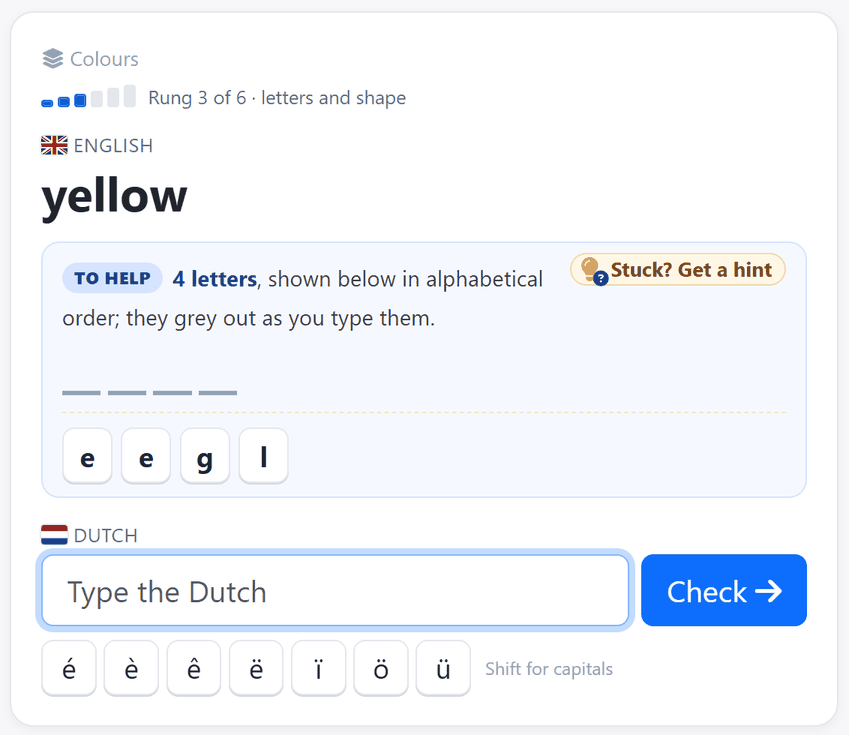
A Wordlark question: the English word, the letters of the answer to help, and a box to type it in

Not a course. No lessons to unlock. Your words, ready to practise in a minute.

What it's for

The words in front of you this week

Most vocabulary has a deadline. Wordlark is for that list, not for a syllabus somebody else wrote.

A test on Friday

Type in the twenty words from the worksheet and practise them until they are no longer a worry.

A chapter a week

Keep pace with the textbook. Each chapter's words, learned as you reach them, and kept fresh afterwards.

A trip next month

The phrases you keep meaning to learn, in whichever language you are about to need.

How it works

Three steps, and the first takes a minute

1

Add your words

Type them, paste them from a document, or pick a list that is already there.

2

Play

A few new words at a time. Each one starts easy and gets harder only as you get it right.

3

Watch them stick

Words you miss come straight back. Words you know step aside. Stars show how far each one has come.

See ita flash card
Pick itfrom six choices
Build itfrom its letters
Shape itknowing its length
Recall ittypos forgiven
Own itexactly right

Every word climbs its own ladder. Get it right and it moves up a rung; stumble twice and it steps back down to where you can manage it. Nobody is thrown in at the deep end.

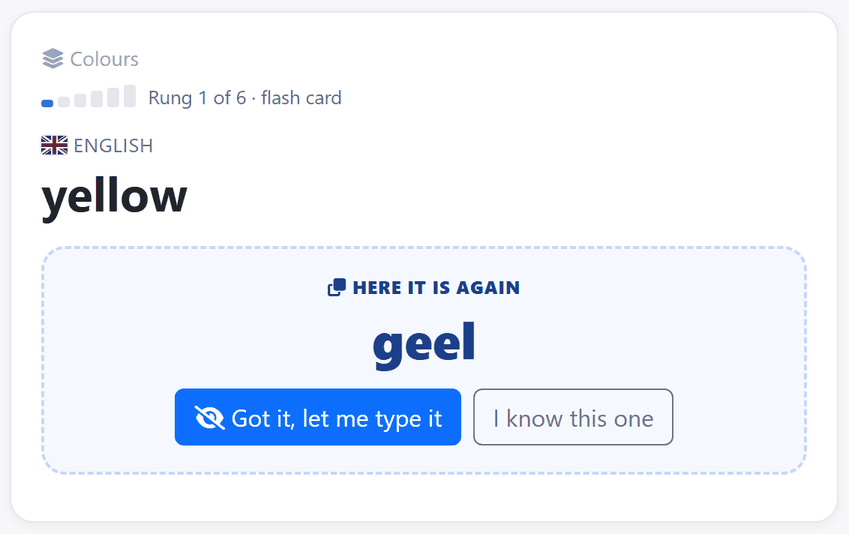
A flash card showing the word yellow and its Dutch translation, geel
First, meet the word. Look, cover, then type it.
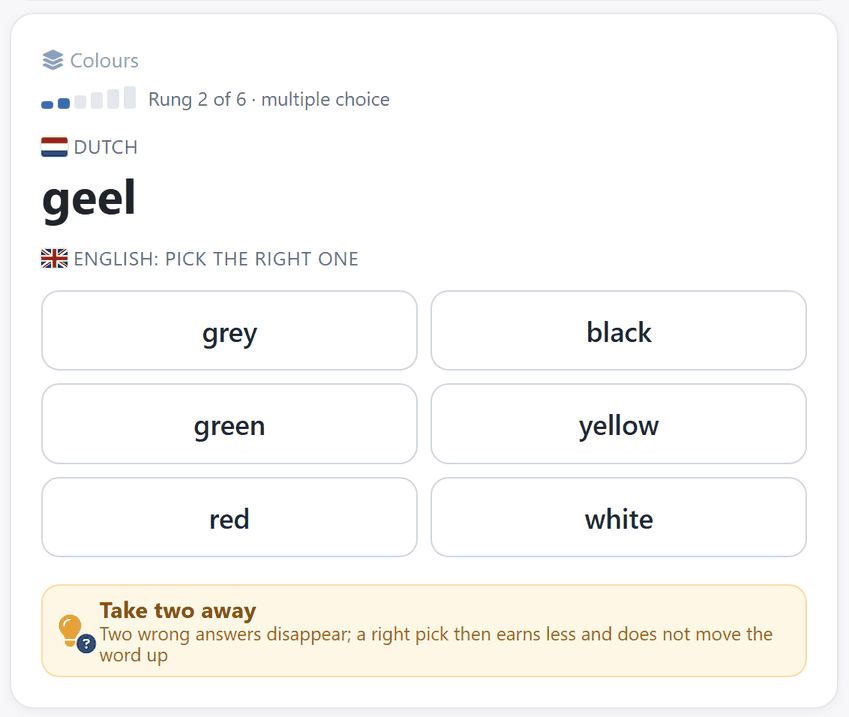
A multiple choice question with six possible answers
Then recognise it. In both directions.
A typing question with the letters of the answer shown as tiles
Then spell it, with less help each time.

Who it's for

For the kitchen table, the commute and the classroom

Anyone with words to learn. It was built for a family, and it works just as well for a grown-up with a course or a teacher with a class.

A parent and child at the kitchen table, practising a word list on a phone
img/for-families.webp, generated from:

Families

For the child with a list to learn, and the parent who would rather not be the one holding it.

  • Ten minutes a day is enough
  • Hints when they are stuck, so they are never simply wrong
  • See exactly which words still need work
  • A leaderboard, if the family is competitive
Start learning
Adults learning vocabulary on a commute and at a cafe
img/for-adults.webp, generated from:

Adults

For the evening class, the move abroad, the professional exam or the holiday. Your list, at your pace.

  • Fits a commute or a coffee break
  • Bring the vocabulary from your own course or book
  • Terms and definitions work as well as languages
  • Any pair of languages, with the accents a tap away
Start learning
A teacher at a whiteboard and pupils practising on tablets and laptops
img/for-schools.webp, generated from:

Schools and teachers

Set the words for the week and every pupil practises exactly those, at their own level, in class or at home.

  • Lists arranged by textbook and chapter
  • Pupils who know a word move on; those who do not get more help
  • Languages, spellings and subject terms
  • Nothing to install: it runs in any browser
Try it with one list

It should feel like a game, because it is one

Practice only works if you come back tomorrow. So there is something to chase every time you play.

⭐ Stars for every word 🔥 Runs of right answers ⚡ Sixty-second lightning rounds 💎 Bonus words worth double 🏆 A family leaderboard 🏁 A daily goal

Plainly put

Wordlark does one thing

It will not teach you grammar or plan your studies, and it is not trying to replace your course, your teacher or the app you already use for those.

It helps you learn the words you have been given, or have chosen, until you know them. That is all, and it is very good at it.

What do you need to know by Friday?

Add your first list and play your first round in the next five minutes.

Start learning